In my latest poetry collection, there’s a poem made out of lines from other people’s poems – a form called a cento, which has a history going back thousands of years. The word ‘cento’ once referred to planting trees, but came to mean patchwork clothing, and then a poetic form made from fragments of other texts sewn or planted together. The cento in Much With Body is called ‘When all this is over is over’ and is made from lines from poems which include the phrase ‘when all this is over’ or ‘when this is over’ (obviously not a complete list). It is an early pandemic poem – a Plague Year Season One poem – responding to both people’s hopeful attachment to Kathleen Jamie’s beautiful poem Lochan that Spring, with its wistful projection ‘when all this over […] probably in June’ and to Boris Johnson’s claim in March 2020 that we could ‘send coronavirus packing’ within 12 weeks.
My knowledge of pandemics is that of a voracious reader and consumer of culture, not of an epidemiologist, but even so to me the idea that we could be seeing an end to the pandemic within such a short time was nakedly unrealistic. The poem knows by the time it really is all over, so much would be broken, lost, reformed. ‘There will be no god when this is over’, the cento repeats, borrowing from Ruth Awad’s amazing poem, ‘The One where I beg’.
Now, in Plague Year Season Three, this poem has an increasingly ironic tone for me, when so many in the literary world are acting as though it is all over, has been over, continues to be all over.
There are fewer and fewer ways to track case numbers in the UK, but we still do have some statistics on deaths, and they are not good. Between April 19th and 22nd there were 1920 covid deaths recorded in the UK. Deaths represent the very tip of the iceberg of the damage covid is doing. By now it is clear how many people have ongoing debilitating effects from even ‘mild’ covid infections months and years afterwards, and recent studies have proved covid causes organ damage, including causing brain abnormalities, and a 72% increased risk of heart failure. The effects of mass infection will be being felt for generations to come. Those of us who know we cannot afford to risk these consequences are frequently made to feel foolish and selfish, for many of us repeating and reinforcing decades of medical gaslighting.
Yet here we are, in April 2022, knowing all this, with maskless indoor in-person events once more standard, and remote options falling away week by week.
I’ve been asking for people to consider retaining remote access for events – first gently; increasingly desperately and pleadingly – for two years now. I am so exhausted by asking. I am far from alone. Around the world I see the same anguished reports from those of us unable to ignore the continued presence of the pandemic, increasingly shut out of cultural activity.
As Vic Wreford-Sinnot wrote last month: ‘the way the arts sector is behaving when the pandemic is still raging is just not normal. The arts are facing some of the biggest moral dilemmas in living history.’
Vic Wreford-Sinnot, ‘Crucial Conversations With Disabled People: Just What is the New Normal?’
Many disabled people found that access to the arts and education opened up for them when nondisabled people needed it. For those who couldn’t attend events in-person before the pandemic, it was bittersweet to suddenly be told access was possible where it had previously been refused.
Many predicted how access would be denied again as soon as nondisabled people no longer demanded it.
This month, London Book Fair justified its decision to run in-person, without mask enforcement, ventilation, or checking of vaccination status or negative tests, after attendees from around the world were infected at it, on the basis that the gathering is ‘key to the publishing industry’.
There are days when I feel there can be no place for disabled creatives in an art world so attached to presenteeism that it will risk the bodies and minds of those who constitute it. What I get back a lot from event organisers is that it’s too hard and/or too expensive to offer remote access. This doesn’t have to be the case.
I’m gathering some of the basic advice I and others have given about remote access here, so I don’t have to keep typing it out, and so it is easy to find in one place.
This is an imperfect gathering of some of my thoughts and some observations of what has been successful for others, and I hope to keep adding to it. If you have any advice or changes to suggest, please get in touch.
BEST PRACTICE FOR EQUALITY OF ACCESS
1. Accessibility for audiences and performers should be considered at the earliest planning stages for every event, not tacked on as an afterthought. If you build accessibility into your planning and funding applications it will be better for everyone.
2. Online & In-Person strands must be treated as equal variations – with benefits for different people’s needs. Don’t describe in-person events as live/real and online events as not real/not live. This reinforces a hierarchy that suggests all online events are substandard substitutes. (I know some of you feel this way but have a heart, I beg thee!)
3. Offer hybrid options as standard for everyone – not just for people you know are disabled or people who make access requests. Remote options give amazing access to people who can’t shift their lives around to go to a town to watch events in-person for 5 days, for eg., but can watch events online whilst making dinner. Don’t make us beg!
4. No one should be made to feel like they have to do in-person or lose work.
5. No one should be forced to disclose medical conditions.
4. There are lots of different ways to make events or whole festivals hybrid. We need to be creative and thoughtful with how we do that.
5. If you’re running hybrid events advertise both strands equally! They are both brilliant for different audiences. You will reach many more people online if you make it obvious how you access your events online and easy to book online tickets.
6. If you are running an in-person event strand, make sure that your in-person events are still as accessible as possible to as many people as possible too. As well as all the normal aspects of making a physical space accessible, this also means putting in place as many protections against covid infection as you can, such as making sure you have good ventilation, and requiring masks unless people are exempt. This makes it safer for everyone.
7. We can’t meet the needs of 100% of the people all the time, but we can do our best, and that means a lot. Trying is better than giving up.
8. Be clear about what the event will involve and make sure everyone involved understands what will happens eg. if it is going online, how long for; how will recordings be used in the future.
9. Don’t forget your online speakers if most of you are in-person! Make sure festival instructions are not just geared towards in-person attendees, and if you usually give an in-person speaker access to other events at a festival with complimentary tickets, make sure you do the same for online speakers for events that are accessible online (even if that’s after the festival itself).
10. Show solidarity! If you’re nondisabled and are invited to work at or attend an in-person event ask questions: will there be remote access options for performers and audiences? will there be masks and ventilation in-person? If you’re involved in running events think: how can I make sure people who can’t attend in-person aren’t excluded from this event? how can I help create a more equitable future? One of the most simple things people can do to show solidarity is to normalise mask-wearing. In an indoor place with other people breathing? wear a mask. It will protect you and others, and make it easier for other people to do it without them being singled out.
WHAT IS REMOTE ACCESS AND HOW DO I DO IT?
Remote access is enabling audiences and/or speakers to attend an event without having to be in a room together.
Remote Access existed long before the pandemic in many forms, from telephone interviews on the radio to videochats, including:
1. Online Events
When everyone needed remote access online events became common, and people got used to speaking and attending events which were online only, on platforms which enable audiences and speakers to interact to different extents including but not limited to:
Zoom
Microsoft Teams
Crowdcast
Instagram Live
Facebook Live
Skype
Some of these platforms enable you to record the event and share it afterwards too, so you can add it to an archive of events on your own website, or through a video hosting platform such as youtube or vimeo.
Provide closed captions on all online events. These can be edited afterwards for accuracy if you’re uploading it after the event has ended. To include signing speakers or attendees, make sure you have Sign Language interpreters.
2. Filmed Events
A filmed event can be shared in real time as an event happens, through a live-streaming platform, or afterwards, on a website or through eg. a youtube or vimeo channel.
There are lots of ways to film an event, from using a smart phone on a tripod, to hiring a film crew, depending on your budget and the size of the event.
Provide close captions on filmed events. These can be edited afterwards for accuracy if you’re uploading it after the event has ended.
To include signing speakers or attendees, make sure you have Sign Language interpreters.
3. Audio Recording of Events
Many literary festivals and event series audio-record events to create an archive that can be shared online (for eg. through soundcloud) or podcasted. This is a form of remote access that can be pretty simple to do.
If sharing audio-only provide a transcript.
4. In-Person events where one or more speakers appear virtually on-screen from a different location.
This was one of the most common forms of remote access for speakers pre-pandemic, and as previous festival director Eleanor Livingstone recently noted, was something StAnza Poetry Festival had been doing since 2009, when a poet’s travel plans failed. Many festivals and conferences have done this to include international writers, or very busy writers who don’t have time to travel! This has also become a common feature of hybrid events.
WHAT IS A HYBRID EVENT?
The word ‘hybrid’ has generally been applied during the pandemic to events which are both in-person and online.
Lots of small events organisers and festivals are complaining (understandably) of the cost of bringing production companies in, but others have found more lo-fi ways to do this and were doing it long before the pandemic. Hybrid doesn’t have to mean expensive with high production values. Jamie Hale, with the support of Spread the Word, has made an excellent guide to making events hybrid without it costing lots or being really complicated, which you can find here, and in the resource list below. Of course, training up your own people to do the tech is the most sustainable option for a hybrid future.
Often people think making an event hybrid means having to live-stream an event whilst it is happening, which can seem daunting to some event organisers, and does require more technical know-how and a decent internet connection. Live-streaming doesn’t have to be complicated, but there are other options to provide remote access too.
Some festivals describe themselves as hybrid when some of their events have remote access, but not all of them, which can be confusing as an audience member trying to work out what you can or cannot access.
Often this means only events seen as big sellers get live-streamed, so some of the more unusual content is not made accessible. Whilst this seems on the surface to make financial sense (you think you’d get a bigger online audience for a famous writer than a lesser known writer with a small following) it doesn’t make sense if that famous writer has lots of other content available online.
What I’d like to see people aiming for in programming is equality of access and equality of experience.
We’re a creative industry, we should be able to be creative about how we make this happen, to make sure everyone gets a good experience. A good experience doesn’t have to be a glossy experience: often what we are seeking is simply to be part of the conversation.
This might mean not, for example, trying to run a single workshop which is simultaneously online and in-person, so the workshop leader has to go back and forth between remote attendees and people in the room with them, but instead offering two different versions of the same workshop: one in-person, and one online.
Some things to consider when planning a hybrid event might be:
What is it about events that make them work and how do I bring that into a hybrid format?
How do we create interaction with online events? (encouraging chat functions for eg.)
Some people are not comfortable being recorded or filmed, so can you think of creative ways to solve that? If pre-recording an event, you can edit out any parts you don’t have consent to broadcast. Do we always need to see people’s faces? Give options!
Red Door Press Keep Festivals Hybrid guide to putting events online. This has lots of handy tech info including details of what equipment you might need for live-streaming.
The Inklusion Guide. Coming soon, this will be an easy-to-use guide to best-practice accessibility across hybrid, online and in-person events.
In Summer 2020 Will and I were commissioned by Aerial festival to make a podcast based on our very local walks during the first UK lockdown for their Sounds of Silence feature of the online version of the festival. The podcast blends bird song we recorded on our walks with reflections on the current situation, and on the ecology of the Lake District, via Mary Armitt’s survey ‘The Birds of Rydal’, first published in the Naturalist in July and August 1902. It’s also a kind of diary of those months in the spring and summer of 2020. I wanted the script to be shared with the podcast for access reasons, but it never was, so here it is. You can listen to the audio here.
Birds of Lakeland/Birds of Lockdown
Eurasian Wren
Eurasian Siskin
Uncertain Ring Ouzel
Uncertain Rook
Almost Certain Eurasian Nuthatch
Almost Certain Mistle Thrush
Uncertain Canada Goose
Uncertain Canada Goose
Polly: I’m Polly Atkin
Will: and I’m Will Smith. We live together in Grasmere, in the heart of the Lake District.
Polly: During lockdown we began to take short daily walks from our home at the south end of Grasmere. Our walks follow a route I often take when I’m at home in the day, a circuit which keeps close to home and avoids busy areas whilst offering peak distraction, in the form of birds, deer, red squirrels, mossy logs and sudden views. I take this walk because my energy and mobility are limited by chronic illness, which puts me at higher than average risk from COVID-19. We take it now together for the same reasons. We can walk out from the house, and if we time it right, meet no one once we get beyond the road. The walk takes us over common ground, between Grasmere and Rydal. There are no gates or stiles to form barriers or disease vectors. We rarely meet other people, only animals, insects, amphibians, birds.
Will: We walked out of the remnants of winter and into a lockdowned spring in which the usual noises of twenty-first century Lakeland life – tourist traffic, airplanes, human feet and voices – were dialed right down, so the voices of the birds and their many neighbours rose up into the space left for them. Red squirrels and deer took over roads and gardens normally noisy with visitors. With no contrails in the sky and few cars on the roads, you could sit on the common between Grasmere and Rydal, and imagine this is what Lakeland sounded like a hundred years ago, or more.
Polly: With the voices of the birds so loud in our ears, we were painfully aware of our inability to recognise them. We could tell them from each other, but we could not be sure who they were.
Will: I’d been reading an essay on field guides by Helen Macdonald, from her new collection Vesper Flights in which she mentions the growing popularity of electronic field guides: apps to help you recognise plants, insects, birds. To Macdonald, these apps take away from the slow, analogue process of mapping a bird’s song or appearance on to a guide book. For her these apps ‘make it harder to learn those things we unconsciously absorb from field guides: family resemblances among species, or their places in the taxanomic order’, as she puts it. Despite this warning, we download BirdNet, an app developed by The Cornell Lab of Ornithology and the Chemnitz University of Technology, which matches audio recordings made in the field against ‘984 of the most common species of North America and Europe’.
Macdonald remembers how as a child ‘field guides made possible the joy of encountering a thing [she] already knew but had never seen before.’ But for us, the opposite happened: using an app formerly introduced us to the rich community of birds that we already knew from their daily presence, but not by name, who otherwise might have remained indecipherable chatter.
Our walks got longer and longer – not in distance – we covered and recovered the same familiar ground of White Moss Common – but in time, as we stopped to record, recognize and talk about the birds we met along the way.
*
Almost Certain Willow Warbler
Almost Certain Garden Warbler
Almost Certain White-Throated Dipper
Almost Certain Common Merganser
Almost Certain Eurasian Magpie
Almost Certain Common Cuckoo
Uncertain Ring Ouzel
Likely Grey Wagtail
Almost Certain Grey Wagtail
Likely wren
*
Polly: Recording birdsong made us think about Mary Louisa Armitt, and her studies of birds in the area over a hundred years ago. Mary Louisa Armitt, known as Louie, was born in Salford in 1851, the youngest of three sisters, encouraged and enabled in their education. Annie, the eldest, wanted to be a writer, Sophia a painter, and Louie a Musician. I can’t help seeing them as a Mancunian analogue to Little Women. Sophia studied at the Manchester School for Art; Louie at the Mechanics Institute. When their father died in 1867, Annie and Sophia had been studying in France, but his death left them with no financial support. They set up a school for younger girls, and continued to educate themselves whilst supporting themselves by educating others.
Annie wrote novels, short stories, poetry and essays. Sophia painted and studied botany, publishing articles on plants and gardening, and writing that would now be thought of as nature writing. Louie published articles on natural history and music criticism.
Will: All three Armitt sisters ended up living in the Lake District. Annie moved to Hawkshead with her husband. Sophia and Louie followed when a small legacy gave them some financial freedom in 1882. Neither married. After Annie’s husband died in 1894 the three sisters moved to Rydal, where they would live together for the rest of their lives, free to read, write, study and create.
*
Will: April 11th. Our first recording. A Eurasian Nuthutch, almost Certain, followed by a Highly Uncertain Common Chiffchaff.
It is a month since the novel coronavirus was declared a pandemic. 917 new deaths have been recorded in the UK in the last twenty-four hours. The total is reaching 1000.
This is the day Matt Hancock appears to blame NHS staff for using too much PPE, whilst Boris Johnson, still in hospital but out of intensive care, makes statements thanking the NHS for his care.
We meet a pair of grey wagtails, who seem to be living in the old bank barn at the top of the road. We see them daily now, dipping in and out of the building, resting with that familiar bobbing motion on the dry stone wall.
Louie describes her own pair which could be ours:
Polly [as Louie]: ‘There is a flash of unaccustomed wings over the wall, and a twitter of excitement. Another, the second bird, drops into the road close by. They are the Grey Wagtails, the first seen this year. They alight near the gutter that runs from the byre and run to and fro, looking for food. They run most nimbly: the balance of their long tails permits their speed, as they chase a fly, to become a dart […] They utter sippity little cries as they run, showing thus the flutter of spirits they are in.’
Will: As we come back down to the road from the common, a tawny owl swoops over a feral ewe as she grazes on the woody path.
*
Polly: By the end of August, the app tells us we have made a total of 1199 observations. It only counts the ones with a valid detection.
Sometimes we record our own footsteps and breathing as much as the birds.
Sometimes a cluster of Canada Geese pass over, honking as they go, and they are all the app can hear.
I love the language of the app. The language of certainty and uncertainty. Detected species ranked by probability.
Sometimes the app says Almost Certain Long-tailed Tit and Uncertain Willow Warbler, but it can’t hear the cuckoo calling spring spring spring.
Sometimes the app says No Confident Detection, and we know how it feels.
Not analysed.
This year, there are times we might all feel like an uncertain treecreeper, an uncertain nuthatch, uncertain siskin, uncertain goldcrest, uncertain rook.
Sometimes the app says highly likely human, and we laugh.
Sometimes is says uncertain human. That is what we all are.
Sometimes it says ‘sorry, we were not able to confidently identify any bird species’. It offers a button you can press to ask it to make a wild guess.
Sometimes that’s the best we can hope for, to tell us what anything means.
*
Will: In 1894, the year the Armitt sisters settle in Rydal, Louie begins to publish observations of bird life in the Naturalist magazine. Her first article in The Naturalist is on ‘Crossbills in the Lake District’, her last, in 1906, is on ‘The Bramble as Food For Birds’. She wrote a regular column of bird observations in the Westmorland Gazette, some of which she gathered and published as a book Studies of Lakeland Birds, in 1897.
Polly [as Louie]: They are the outcomes of some leisured years of country life, when delight in the songs and ways of birds had fixed observation into a habit, and this had already filled a six-year’s diary with copious notes. They were begun simply upon an impulse to record what was known by the writer of the life-history of some particular species […] They profess to be no more than studies, taken from the life, by an amateur. […] They profess to be true — with a truth as perceived by but one set of faulty human senses! — of the birds of one neighbourhood or district alone.
MLA, Rydal Cottage, March 1897.
*
Polly: We are very amateur. Much more than Louie. When we begin, the sounds we know by heart are only the most obvious ones. The noisy ones. Cuckoo cuckoo. Corvids. Geese. Over the summer, we learn to distinguish the songbirds from each other. We know now when it is the chaffinch shouting. We know the thin high-pitched song of the goldcrest. The bolshy wren. We know that one particular song thrush always singing its heart out from the top of the same thin tree. We can’t promise we will remember, next month, next year, but for this one summer we know our neighbours’ names.
*
Will: After she died, Willingham Rawnsley – brother of Canon Hardwicke Rawnsley, one of the co-founders of the National Trust – gathered Louie’s local writings and published them. First, in 1912, he published her history of Grasmere Church, just a year after her death. In 1916 he published a collection of her writings about Rydal.
Polly: In the introduction he lays out how important birds were to her life, and her happiness.
Will [as Willingham]: Her keenest enjoyment was in the little expeditions, some of which we had together, in search of some rare or notable bird. Every bird was known to her, his habitat, his dates of migration, his note, his method of nesting, and all that a bird would be at most pains to conceal, was to her an open book. The Pied Flycatcher, the migratory Wagtails, the Dipper, his song, his singular habits and the discovery of his nest were an annual delight to her. The circling Buzzards were, I might almost say, her familiar friends.
Together we went to call on the black and white “Tufted Duck,” and found him at home without fail on “Priests Pot” near Hawkshead ; and the crested Grebe, though not so easy to see, was not far off on Esthwaite, near which Miss Armitt noted with satisfaction the increasing number of Redshanks, reported by that very “rara avis” a Naturalist gamekeeper to be nesting thereabout. Her face lit up with pleasure when I described to her the Woodcock who alighted close to me on the lawn at Loughrigg Holme in order to get a firmer hold of the young one she was carrying in her claws, and who tried to wriggle away from her grasp. But the greatest delight of all was the sight, early in the spring, of a Mother Snipe and her three young ones on the Little Langdale road. We pulled up close to them, and when the mother flew into the grass on one side of the road the little ones ran back to the other side and in a moment, squatting close, were so hidden that we could not find a trace of them, though all the time they were within a few feet of us.
*
Polly: The Rydal book includes as an appendix Louie’s study ‘The Birds of Rydal’, a survey first published in the Naturalist in July and August 1902.
The seventeen pages of ‘The Birds of Rydal’ form a unique record of bird life and activity in the area at the turn of the twentieth century.
She lists 103 species, from permanent residents including pheasants, coots, moorhens, woodcocks, herons, mallards, kestrels, wrens, dippers, treecreepers, finches and tits to regular winter or summer visitants, and the occasional visitor, like the waxwing or the teal, or great crested grebe.
Enfolded in her account of the birds are accounts of change and loss over time. Numbers falling; species vanishing, and new ones appearing. Raptors are persecuted, nests harried, breeding adults shot. Some birds’ presence is only affirmed to her by their dead bodies.
Of the Curlew, now so emblematic of population decline, she writes:
Will [as Louie]: Occasional visitor only, as it no longer breeds on Loughrigg. Its quavering cry is heard in early spring, as it moves to its nesting quarters, on the rough heights (Black Fell, Hawkshead Moor, etc.) round the head of Esthwaite Lake. In the late summer of 1898, when I had word that it was unusually numerous on its breeding ground, it pushed the incursions it makes into the Esthwaite hay meadows (when these were shorn of grass) as far as this parish. Nine or ten birds were about in the last days of July.
Polly: Lapwings too are losing their territory in 1902, with only a few known to be nesting in sheltered sites. They come too early, and fail. Louie writes ‘I have a note of its arrival on the marsh on 10th January, 1890 ; and was told of a flock on Grasmere Marsh on 14th January, 1900 ; but these too-early incursions are followed by withdrawals.’
Will: ‘The Birds of Rydal’ is a record not just of life in a particular moment in time, but of climate change, of habitat destruction and species loss.
There are birds in Louie’s list that we have not seen in Grasmere or Rydal.
There are no longer starlings ‘in almost every house’: we’re not sure we’ve ever seen one here.
We have heard a Curlew flying over, but not seen one on the ground. We have never seen a Lapwing here, nor a Woodcock, nor a Night Jar, though some of these may be for want of looking in the right places at the right times.
But there are also birds that are disappearing from Louie’s time that are thriving, or at least surviving, in ours.
Of the Great Spotted Woodpecker, she laments ‘I have been unable to find it myself, nor has the squire seen it for eight or more years’, when this summer we could not escape from them: everywhere we went it seemed a Great Spotted Woodpecker was there before us, or following after.
The house martins and swallows she notes as summer visitants, but not abundant, have been many when we’ve known them, especially the martins, who have a vast colony under the eaves of a hotel.
Polly: We picked up the song of Chiffchaffs regularly on our walks, which Louie calls ‘somewhat rare in the Lake country.’ Long-tailed tits, which she calls ‘not very numerous’, go about in great mobs, especially in the winter, when they descend on the bird feeder in a cheeping blizzard. I love the little baubles of their bodies.
Without the app recognising its voice, we would not be able to tell you that we crossed paths with several Ring Ouzel, which Louie notes as ‘rare in Lakeland, where ground fruits such as belong to true moor-lands are scarce.’
Most striking is the turn about in the status of the Goldfinch, who in Louie’s time lives only in ‘the memory of middle-aged men’, who in her notes recall it flocking in autumn on Loughrigg. Louie never saw a Goldfinch here, but we see enough that we think of it as a regular.
There are losses, there are gains. There is hope.
Once or twice this summer, I was sure I saw and heard a Sky-Lark, but I can’t be certain. Not even almost certain.
Louie tells us that in 1902:
Will [as Louie]: ‘This bird is practically absent from Lakeland, where, according to an old inhabitant, it once existed in fair numbers, a change ascribed to the lapse of old corn-lands into pasture and meadow. But it is a remarkable fact that a few pairs return each summer to nest on the summit of our mountain range. It is to be heard singing, I am told, on almost the topmost height of Fairfield; and the farmer, whose sheep range over the slopes, has found its nest towards the top of the spur called Heron Crag.’
Polly: I might have dreamt a sky lark or the ghost of a sky lark, or maybe the great great great great grandchildren of the pairs Louie hears about do still return, after all.
*
Highly Likely Common Redstart
Almost Certain Common Redstart
Highly Likely Eurasian Blackcap
Almost Certain Eurasian Jay
Almost Certain Pied Flycatcher
Almost Certain Spotted Flycatcher
Almost Certain Eurasian Oystercatcher
Highly Uncertain Great Spotted Woodpecker
Almost Certain European Green Woodpecker
Likely Carrion Crow
*
Will: Willingham Rawnsley records that Louie was ‘for years more or less of an invalid’. One biographical note says that by the time she was living in Rydal, writing about the birds around her home, Louie ‘was so ill with heart trouble that she was prevented from travelling far’. Her local focus is a necessity, not a choice, but she finds beauty and use in it. She takes out a subscription to the London library, who send books North to her. She writes articles on Rydal Beetles, on Observations on Spiders at Rydal.
Polly: I know how it feels to have your movements limited by illness. I know how watching birds flit about can bring a kind of vicarious movement. How their voices feel like company, how their lives can make a life less small and alone. How they become dear friends to you, whether they know it or not.
*
Highly Likely Coaltit
Highly Likely Great Tit
Almost Certain Tree Pipit
Almost Certain Meadow Pipit
Almost Certain Long-Tailed Tit
Almost Certain Marsh tit
Almost Certain Dunnock
Almost Certain Tawny Owl
*
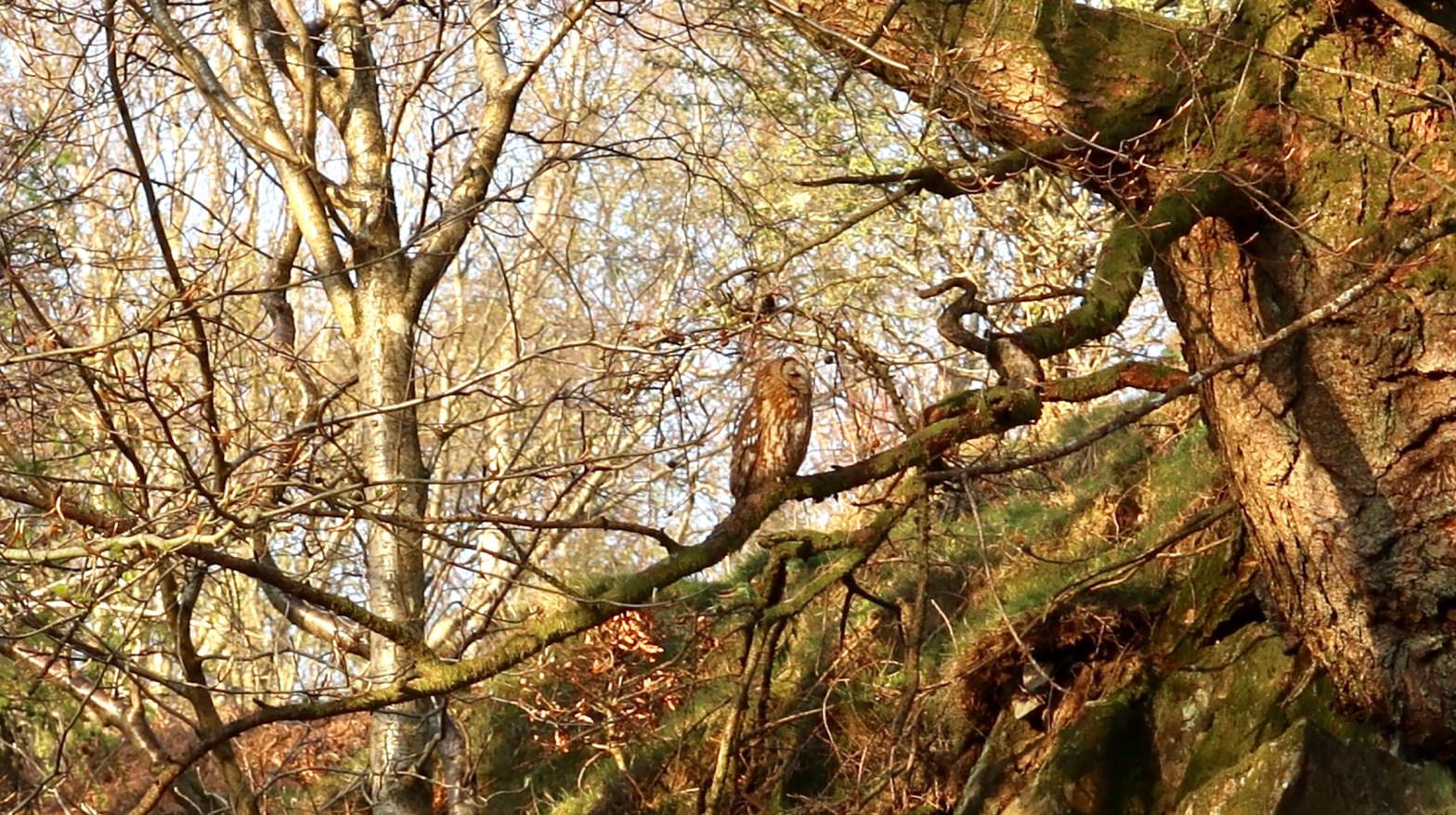
Polly: The first time we see the owl up close is on April 13th.
It’s not that we didn’t know it – or they – were there before.
There was a time a few years ago you could see a tawny owl every afternoon, sitting in the same tree.
The owls are always here though, whether we see them or not.
We know they’re hear because they come down to the house at night. Sometimes their calls are so loud and close they seem to be perching on the outside of our bedroom window sill.
It always makes me think of Neko Case’s song ‘This Tornado Loves You’ – my love, I’m an owl on the sill in the evening …
Do you remember the time we were driving back from seeing Neko Case in Manchester, and an owl crossed our path, just by Rydal Water?
I thought it was going to hit the windscreen, but it just skimmed us, settling in a tree overhanging the lake.
Will: The owl is listed by Louie in her Birds of Rydal. She calls it a Wood Owl, and gives it the taxonomy Syrnium Aluco, but now we call it Tawny Owl or Brown Owl, or Strix Aluco. All she says about the owl is ‘Permanent resident. Abundant.’
We know they are here, but abundant now doesn’t quite seem the right description. Permanent resident. Still present. Hanging on to their territory. Surprisingly resilient.
Polly [singing]: The owl the owl is a lonesome bird She fills my heart with dread and terror That’s somebody’s blood there on her wing That’s somebody’s blood there on her feather
Will: In April our walking hour coincides with the owl’s hunting hour, and it seems every day we disturb her as we go. She is always three trees ahead of us. Our noise unsettles her, sends her swooping away from us.
On April 13th we manage, accidentally, to sneak up on her. It is a bright evening; long yellow sun making everything tawny. She is resting on a mossy branch in almost direct sunlight, intently watching something on the ground. Eventually she turns to return our gaze.
April 13th 2020. Global cases of Covid-19 surpass 1.85 million; deaths 114,000.
Polly: After that, we see the owl often, mostly from a distance, sometimes close by as she waits out the lengthening light in a safe nook. Sometimes we can’t pick her out from branches until we are too close for her comfort and she has to unfold herself and remove herself to a quieter spot. These nights, in particular, she seems to come down the hill to the house after dark, and call outside our bedroom, as if to say I know where you live too.
*
Will: April 22nd 2020. First sighting of swallows wheeling in the sky over How Top Farmhouse, and the barns where they nest every year.
Global deaths from Covid-19 have surpassed 175,000. In the UK, they are estimated at 16,500.
In America, Donald Trump has announced a 60-day ban on immigration.
On the news they warn of global famine, global economic collapse.
The world for each of us seems to be getting smaller, and bleaker.
But here, our summer migrants are arriving in number.
Not so much a sign the world is still working, but that some kinds of life will go on.
Louie wrote that the swallow has served mankind ‘as a symbol of great mysteries. It has been to him a visible token of invisible things. Cosmic forces – the position of the earth towards the sun and its varied movements, the year and the season […] It came with the warmth, it went with the cold, becoming thus a winged type of summer itself, of love and joy.’
*
Almost Certain European Greenfinch
Almost certain Common chaffinch
Almost Certain Eurasian Bullfinch
Almost Certain Common Chiffchaff
Almost Certain European Stonechat
Almost Certain Eurasian Blackcap
Almost Certain Common Blackbird
Highly Likely Tree Pipit
Likely Collared Dove
*
Will: In May 1898 Louie writes that spring always comes as a surprise, somehow, ‘with a quick transition that makes a magical effect’.
Polly as Louie: ‘It is at this moment of spring, upon the sudden bursting of the green, that our summer birds arrive. To be sure, they have begun to come before – some few of them, with the first of the green; but now they come species after species, in numbers. Suddenly like the green, they are here. The wood that, a fortnight since, was vacant and silent, now resounds with the songs of a multitude of birds.’
Will: In May 2020, the willow warblers, wood warblers and chiff chaffs have arrived, and are busy on the common and in the wood. We hear the tree pipits and meadow pipits and redstarts, who flit from tree to tree above us as we walk.
On May 25th we meet a pair of Mistle Thrushes on the common, and see a pair of Great Spotted Woodpeckers together in the wood for the first time. We know the Woodpeckers predate the other birds’ nests, but we are still excited to see them.
In Central Park, New York, a black birdwatcher, Christian Cooper, has the police called on him by a white woman for asking her to put her dog on a lead.
On the same day, in Minneapolis, a white police officer kneels on the neck of a black man, George Floyd, for over eight minutes, until he is dead, and the year’s meaning shifts.
The summer blooms into a summer of protest, of uprising, resounding with the songs of a multitude too.
*
Polly: In mid-July the comet cuts a line down the sky, like an endtimes sign from a dead century. The weather is changeable this month. We choose what turns out to be the one clear night to walk up to the wishing gate and watch for it. We’re too early, in the light of midsummer, and have to linger by the wood until it gets dark enough for the stars to show themselves. It’s cold. As we wait, bats flitting around us, a strange crying comes from the trees. It is not a voice we know. It sounds like a wounded animal, urgent and alarmed. Alarming. We try the app and the app says human. We try the app again and the app says pheasant. We try the app again says goldcrest and then we are sure the app is baffled. We shine our torches into the night wood and see nothing. The cry keeps coming.
We record the cry and take our own guess. Hungry owl baby. Hidden in the dark. We comfort ourselves that we know the difference between an owl and a human, or we think we do, when we have a home to go into, and lights to turn on.
And when we do go in, finding we are still wearing our human faces after all, we check our human owl baby cries against recordings, and find our guess was correct.
*
Highly Uncertain Common Kestrel
Highly Uncertain Little Grebe
Highly Uncertain Common Buzzard
Highly Uncertain Greylag Goose
Almost Certain Common House Martin
Almost Certain Common Swift
Almost Certain Western Jackdaw
Almost Certain Eurasian Siskin
Almost Certain European Robin
Almost Certain Song Thrush
Likely Raven
Likely Wood Pigeon
Uncertain Grey Heron
Uncertain Grey Wagtail
Uncertain Goldcrest
Uncertain Human
*
Polly: Willingham writes a postscript to his editor’s note on Louie’s Rydal book, which seems resonant now in a peculiar way, as we float in the timeless limbo of this plague year:
Will [as Willingam]: The editor had hoped to complete long ago the task left him to do. But the war, which has everywhere borne heavily on printer and publisher, has caused one delay after another. Still, if such Antiquarian studies as Miss Armitt had spent the latter years of her life over are worth anything, I must agree with Professor Haverfield that, ‘even in war-time, it does not seem necessary or desirable to drop all intellectual work […] save in the direst need.’ […] With this strong opinion to uphold me I have thought it best to bring this book out at once, hoping that it will be found of permanent interest far beyond the immediate neighbourhood of Rydal, rather than wait for the end of the war, an event whose date lies yet upon the knees of the gods.
Polly: I hate the language of war applied to illness. It says that if you die you just weren’t strong enough or valiant enough to live. You didn’t try hard enough. You were a bad solider. You let the side down. If you live but don’t get better you’re a deserter from the army of the well, no longer productive.
If I die and anyone dares to utter those words ‘lost her battle with’ or – worse ‘fought a valiant battle with but lost in the end’ I will haunt them until they give up the fight themselves.
It seems even worse tacked onto a pandemic.
Will: July 17th. Boris Johnson tells us ‘we must carry on waging this long, hard fight against Coronavirus’, as though he thinks we are at war with Covid-19. If we are, we can only lose. No military force can beat a virus. No personal strength can either.
On this day, the UK death toll from Covid-19 rises to 45, 233 people. Global cases surpass 14 Million.
A pandemic won’t respect your borders or your armies. It doesn’t care how many nukes you have stashed away. You can’t drop a bomb on it. You can’t incarcerate its soldiers. You can’t change its mind.
But when we read Willingham’s words from 1916 the end of the war, an event whose date lies yet upon the knees of the gods we can’t help feeling those words also speak to 2020.
*
Polly: August 24th. An owl is calling outside our window.
She has come down from the woods, as she always does.
The app says No confident Detection. The app says the voice in the night is a shapeshifter, calls her a human, then a coot, then a buzzard, then a jay. Cannot place her. Cannot assign her a body or a history.
But we know her. We don’t need an app to tell us her name.
*
Will: August 26th. The birds are quieter now. Week by week it is harder to pick out their songs over the busy summer holiday traffic, busier than a normal year. The summer migrants are preparing to leave us. Louie notes how the birds songs lose their power in late summer, that even though they still sing, ‘these last songs do but sound their own death-knells. They tell us in audible gasp they are at an end.’
In the garden we hear a sudden eruption of sound, and it comes as a shock now. It is a cluster of nuthatches all talking at once.
Polly: Amongst the nuthatches we’ve recorded me too, saying I can’t see them but I know they’re there. It’s like applause.
This month the news has been of migrants drowning in search of a safer life. Of rigged elections. Of avoidable tragedy. Covid-19 cases worldwide have reached 24 million. Two Black Lives Matter protestors were shot dead by a white teenager with a rifle in Kenosha, Wisconsin, as they marched in solidarity with Jacob Blake, paralysed when a policeman shot him seven times in the back.
Will: This has been a summer of loss, in so many ways, for so many people. A summer of grief, and anger and despair. But the birds keep singing. They built their nests, they hatched their young, they fledged – they carried on – against great and terrible odds, as they always do. Whether you take that as a sign of hope – of resilience, of resistance – or of indifference – is up to you. To us, the birds showed us the power of continuation – how a grey wagtail can dart out of 1897 into 2020 and bring its flutter of spirits into our dreich existence. They remind us that another spring will come.
Louie writes on ‘The Last Song of Summer’:
Polly [as Louie]: Then will come the time of steady silence, marked by but a few rare sounds. The chiff-chaff’s ceaseless chant, the goldcrest’s thin and scratchy tune do hardly count, devoid of melody as they are. It is only the yellow-hammer’s ditty on the fells, the wren’s gay song as he nests yet again, or maybe the willow warbler’s few tones of real reminiscent sweetness, that will fall on our ears now and then in the stillness, like spots of light in darkness to the eye. They will recall to us through the silence the days gone by of music and melody, spring-time and love; they will make the void felt, until our robin, rousing from his moulting-rest, shall start the new songs of autumn.
Dear reader, I cannot lie to you. This last two years have been trying. At this point in 2020 I couldn’t face looking back at the year. I suppose that I am writing this now proves the point I make so often about adjusting to chronic illness: it’s continually surprising the amount of daily pain you can learn to get used to. It doesn’t stop being pain, but it becomes part of your life, mundane, unremarkable, unexceptional. Every now and again it becomes suddenly unbearable again, and you have shifted back through the spiral of grief and acceptance. That is how I feel about the pandemic. How I feel now, writing this, fizzling once again with anger and frustration.
Despite this, there have been moments of joy and beauty, as with any old year in a chronic life.
In 2020, after an initial panic in early March that I’d lost all my paid work, and wasn’t eligible for freelance support (I think because of the tiny amount of money I’ve earnt from academic teaching most years), some online events and nonfiction commissions came through, for which I remain unspeakably thankful. I had an essay, ‘Commonality’, about local walks during lockdown commissioned by PLACE 2020; an essay/podcast ‘The Road North Through’ on walking around Lancaster by Lancaster Litfest; and an hybrid audio-essay ‘Birds of Lakeland/Birds of Lockdown’ with my partner Will commissioned by Aerial Festival, which interweaves birdsong recorded on ours daily walks with reflections on the pandemic, and the history of birds in the area. These pieces of work gave me hope and purpose in a bleak time, and, importantly, paid decently.
Another high point was a two-week residency at Cove Park. I’d been eyeing up the Cove Park residency for over a decade, and was so excited to get called for interview in February 2020. I stopped for two nights in Arrochar on my way to StAnza, and whilst I was there, posters calling for guests to wash their hands and keep their distance from one another appeared in the lifts and corridors.
Arrochar, February 2020
In St.Andrews, I overheard a shop assistance and a customer talking about how they knew they wouldn’t get ill, because they were clean people who never got ill. I had words, and left. Sometimes I wonder how those two have fared since. I already knew then that when I got home I would enter my own lockdown, but even with my most long-vision specs on, I don’t think I believed it would last this long. My residency was scheduled for late spring, but of course, it was postponed. Instead, I spent two weeks in October staying there, on that hill between lochs, in beautiful self-contained safety, but with a different view. Most days I went down to the loch to look for the Northern Bottlenose Whales who were ill-advisedly visiting. I didn’t sleep much, but I swam in the sea for the first time since March, and it was wonderful. This September, Will and I returned to the area for a too-brief four night break – his first holiday since before the Pandemic.
Vital Spark, for sale, at the end of the rainbow.
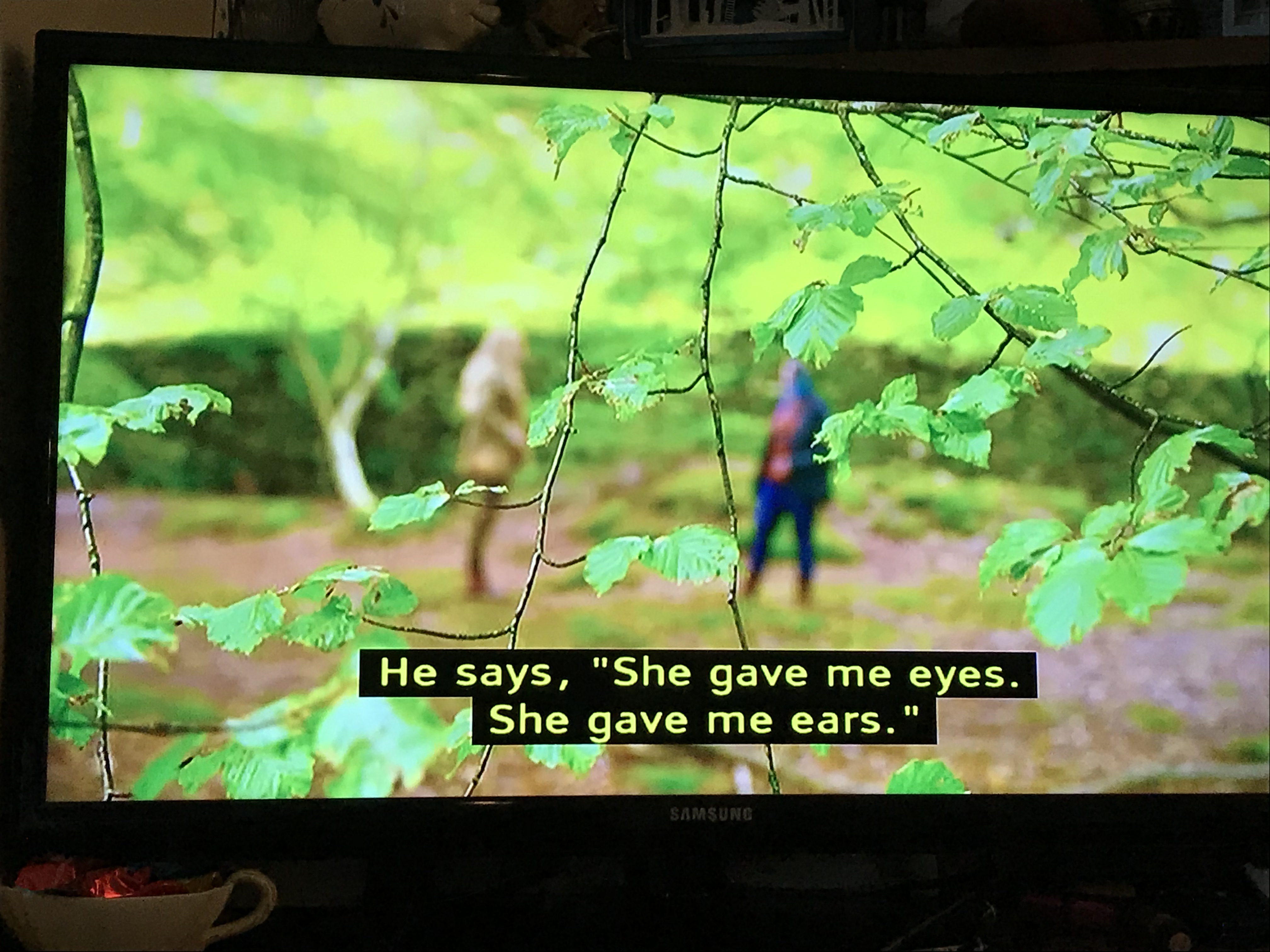
What else should I say about 2020? I was on BBC Countryfile in September, talking to Ellie Harrison about Dorothy Wordsworth, and swimming. My nephews, who live abroad and I haven’t seen now for two and a half years, said I looked like a swooping stingray under the water. In November I hosted filmed events for Kendal Mountain Literature Festival, and they went online, and got hundreds of viewers. I survived. That was the first plague year.
On Countryfile
The biggest thing that has happened this year for me is that I published two books: two books within almost a month of each other. It happened this way through coincidence, not planning.
The first, out in October, is my second poetry collection, Much With Body. I knew this was coming, and the shape of the book, though it didn’t take its (almost) final form till January 2021.
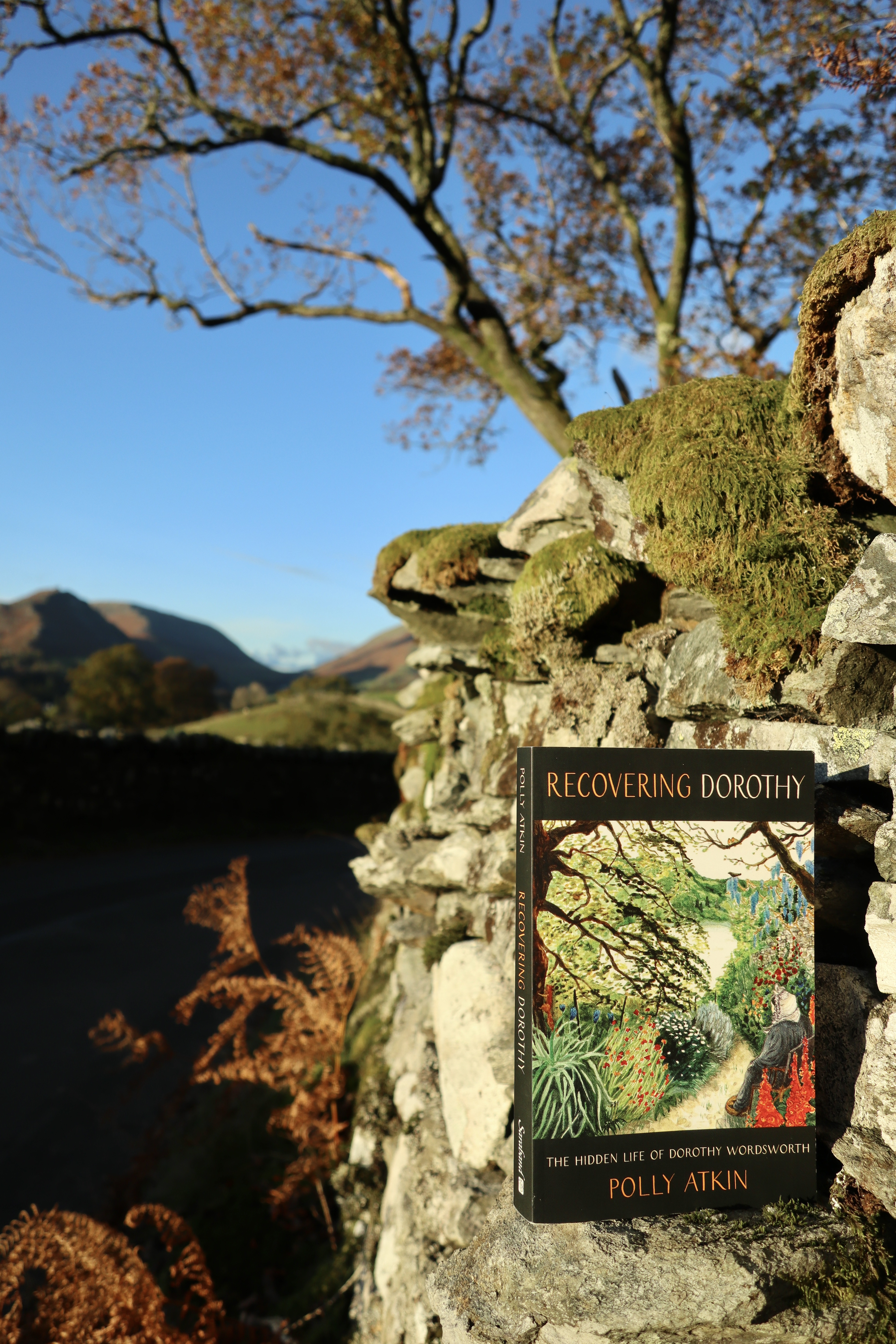
Meanwhile, in July 2020, I had signed a contract with Saraband to write a biography of Dorothy Wordsworth, to mark her 250th, with a new angle. Dorothy is well known for her journals kept from 1798-1803, and as a woman who walked and climbed. It is less well known that in her late fifties she became seriously ill, and after five years of acute health crises, was housebound for the last twenty years of her life. Her story is one of disability history, which like many such histories, has been hidden.
Recovering Dorothyis the first book to really look at her illness, and at those years of her life. It aims to recentre her in her own life story and recognise her as a disabled writer. There is a lot of pain in this book, but also beauty & joy. There is poetry. There are pet robins. There is aurora borealis at Christmas. There are ‘misty mizzling bird chaunting morning[s]’. I wanted to give Dorothy the same respect anyone deserves when they try to articulate their pain: to be listened to, and to be believed.
I wouldn’t recommend writing a book in less than a year, especially one with so much research behind it, especially when you are living with energy-limiting illnesses during a slow apocalypse. But I got there. It ate most of the year, and I’m still recovering from it, but we got there. I’m so grateful to Sara Hunt at Saraband for taking the book on, and following my vision for it, and bearing with me through the rush to get it together and out.
A lot of this year has also been taken up with applying for funding to commission new work and a series of online events to celebrate #DW250. We had our first event in December, a week before Dorothy’s Christmas-Day birthday. I can’t wait to see what comes of all the commissions.
As I wrote through Spring 2021 I realised I was writing in a strange kind of parallel to Dorothy in 1830, as she entered the first Spring after her serious illness. The irony of writing about a lost piece of disability history – about a woman who could not leave her house or garden – during a time I could rarely leave mine – was not lost on me, and I really want to write more about that peculiar experience.
Living through the 1830s with Dorothy showed me different ways to see beyond geographical limitation. When she cannot leave her room, she brings the garden into her room. Robins nest above her bed. When the sun comes out after rain it seems to her ‘unearthly & brilliant’, she sees ‘every leaf a golden lamp – every twig bedropped with a diamond’. Imagination, memory and poetry become ways to travel when she cannot. This is what Dorothy reminded me: to see the beauty in what was right in front of me, and to bring the world to me, if I can’t go to it.
Unfortunately, this became harder after so-called ‘freedom day’ in England, particularly as arts organisations rushed to return to in-person events as soon as it was allowed. All the paid online workshops and talks I had in 2020 began to trickle out. I love doing talks, workshops, panels – anything! – in any time zone! But I’m facing now my third year of lockdown with barely any work booked in for 2022. I’m trying not to panic too much about that.
There is a campaign started by novelist Penny Batchelor and her publisher Red Door to #KeepFestivalsHybrid. As they put it:
Online events enabled disabled authors who are unable to travel to promote their work on a level playing field with other writers. They also widened participation to include readers who couldn’t afford to pay travel costs on top of the ticket price or who may have been put off attending in person events by social anxiety or simply the thought that the literary world was not open to them.
Open Letter to Literature Festival Organisers
There are so many of us who have found work has dried up or disappeared this last six months, after an extraordinary opening up of the virtual world during the first months of the pandemic. Housebound writers who couldn’t access the arts at all were suddenly able to attend events and festivals and speak at them. I know there were great loses too, but this seemed like one wonderful thing we could all learn from. We were told we were being cynical and pessimistic if we dared say we worried remote access would disappear again as soon as abled people no longer thought they needed it, but this is precisely what has happened. I feel disproportionately grateful to those organisations who have given me remote access as a speaker or audience this year (particularly those who offered it without me having to beg first) and those who continue to prioritise access as we go forward.
Thanks also to all the readers and all the booksellers who have read and championed my books, and continue to put them into other readers’ hands. In any year it means a lot, but this year it means everything. Every one of you makes a difference. I’ve loved seeing pictures of my books out in the world when I can’t be there, having experiences I can’t have at the moment.
I can’t imagine what the year ahead will hold. I’m scared, of so many things. That isolation will be reduced or erased and my essential health appointments will be increasingly unsafe. That the well world will open up more and more and forget entirely about those of us who know we can’t afford to ignore the ongoing pandemic. That people will get angrier and angrier if you remind them of this.
I am grateful for the company of other disabled writers who make me feel less alone in all this, especially the ADCI group and the Experimental Writers group. I’m grateful for friends and family who keep in touch online, and for the technology that allows us to. I’m grateful for my partner and the cat who chose us, and our little garden, and our neighbours, and every small thing that makes every day bearable.
When I’m having a weeping day rather than a singing day, I’ll think of Dorothy and work on bringing the world into my room, and hope that the world still wants to come in. That’s all I can do. As for the rest, only time will tell.
What does it mean to live ecologically? If I make a list and share it on twitter can I prove to you I’m living ecologically?
Am I living ecologically if eat seasonally and locally or only if I eat plant-based food sourced globally? I put on the heating whenever I need it, but our supplier is Green. Is that living ecologically?
Should we all live off grid, and break off connectivity?
Can I offset the eco-shame of car-use with childlessness? Does it offset the offset that my childessness is not something I chose for the sake of the planet?
Dock 10 points for eating animal products.
Dock 5 points for living with a cat.
If I go to a protest to fight for the planet and clean up after myself using caustic chemicals, is that living ecologically? If I stay home and save fuel, is that living ecologically?
What if I only stay home because of disability? Is that sustainable? Is this the Green Life?
To sit at home and grimace at the news is ecological.
To take the tv to recycling is ecological.
If I use environmentally-friendly cleaning products, on my own body and on the body of my dwelling place, is that living ecologically? Is it better to be dirty? To save water and electricity?
What if I use those products because I care about the planet, yes, but mostly because I care about my body? My body is a sensitive ecosystem. I am my own canary. Dock 10 points for shedding scales of plastic medication packets. You can never be zero-waste. Dock 5 points for not renouncing travel. Dock 5 points for not believing in anthroporn.
Dock 20 points for not protesting enough.
*
Sometime way back in those heady days before we lived in a global pandemic, I got in an argument with a man I didn’t know on the socials. It started with a mutual friend sharing an article about car-free cities, and suggesting our own very mountainous, rural area adopt car-free policies.
Me: It’s worth considering that focusing on bikes as ideal travel excludes many disabled people, many people with illnesses causing pain & fatigue & people who simply cant ride a bike. It’s not a transport solution that can work for the masses especially in a landscape like ours. Man On Internet: Bikes/cycling is the only long term solution that can work for the masses in the Lakes. Other forms of access could be provided for the tiny minority unable to use them however with e-bikes/trikes, recumbants, tag alongs, trailors, tandems etc. most are catered for.
Me: I don’t class disabled people or people who can’t cycle for medical or other reasons as a ‘tiny minority’ and I’d love to see a full work up of how you’d expect to move people like me around with any of those suggestions on a daily basis without further marginalising us. #ableism
Man On Internet: As I said others forms of transport can be made available or those unable to use any of the forms bike based transport I suggested. For example expanding the current [tourist minibus] Service & even specialising it further to provide for those who need it.
Me: I really don’t understand how that’s going to help me get to the shops, the doctors, work, to meet friends? I don’t think you’ve thought this one through or talked to any disabled people.
Man On Internet: If fact your access would be vastly improved as the roads would no longer be clogged with vast numbers of unneccasry tourist motor vehicles, only those that geniunly need to be there like yourself.
Me: Who would decide who genuinely needs it? Who would police it – because there’s nothing folk like more than policing who is ‘genuinely’ disabled or not. Yes, bike access is great, and encouraging cycling is super, but it’s not a mass transport solution.
Man On Internet: Cycling is the perfect mass transport solution. Low enviromental impact, affordable, uses least amount of space/per person, good for health. It isn’t going to be suitable for everyone & there needs to be options for those who need them but it is the future of personal transport.
Me: Cycling can’t be a mass solution in an area like ours where people have to travel large distances for daily purposes, where it is very hilly, and has a lot of adverse weather. It’s not practical for the majority. Why not focus on decent public transport instead?
Man On Internet: All of the previous with the caveat that alternative options/facilities remain for those who need them like yourself. I’m not proposing a system which would isolate individuals who cannot cycle.
Me: Thanks for not listening to any of my opinions about this.
*
This is one iteration of an argument I have had countless times. It’s not always about banning cars versus improving public transport. Sometimes it’s about banning plastic straws versus disabled lives. Sometimes it’s about banning bottled water versus ensuring access to drinking water. I’ve had it countless times, this argument, mostly with well-meaning, good-hearted people who care deeply for the earth. But who don’t care to muddle their priorities by really listening to disabled people about their lived experiences. It’s too contradictory, too complicated.
I thought about disclosing my disability at this point to help you understand my position, but then I remembered no one should have to disclose their disability to have their needs understood. The person who is telling you their needs understands their own needs. Believe them.
Disability activist Annie Segarra coined the phrase ‘The Future is Accessible’ as ‘a call for visibility and intersectionality […] a call to prioritize equity and accessibility’. Yet the futures imagined by many environmental justice movements are futures which are definitely not accessible.
Like the zombie apocalypse, they are worlds I know I would not survive.
I wrote this piece two and a half years ago, for an online journal that has not yet launched. These are things I’ve thought about a lot during the pandemic. Especially that last sentence; most especially that last sentence. Sometimes in our house we replace words alluding to the pandemic with the words ‘Zombie Apocalypse’, to check how sensible the statements are. For example, ‘what we’re doing is trying to take a balanced and proportionate approach to the particular risk that seems to be posed by The Zombie Apocalypse’. For example, ‘we now have to move into a different period where we learn to live with the Zombie Apocalypse; we take precautions and we as individuals take personal responsibility’.
Many of us hoped the pandemic would create more understanding of illness; what it is like to live with limitation; more empathy for disabled people. But instead we watched as we were characterised as expendable, over and over again, on every news bulletin. Our lives were presented as acceptable losses.
And I find myself back in that looping argument again, even as the pandemic still rages on in the background, ignored by those who think they can afford to. There are so many ways to protect the earth that don’t also harm disabled people. Can we start to focus on those?
If your green utopia does not include disabled people and meet their needs, it is not a utopia, it is a dystopia. And I, for one, have had enough of a taste of that.
Back a million years ago in the year 2008 I had a bit of a sad Christmas. There were no terrible reasons for it, I just couldn’t find much Christmas Spirit in myself or the world. I was lonely, and felt a bit useless, like I was failing at everything. As I often do, I found some solace in music. Not in happy songs to cheer me up, but sad songs to normalise not being happy.
If I’m feeling sad or lonely or heavy with despair at the state of the world or my life it’s always art that reflects that that I turn to. I need sad songs in my sadness; lonely songs in my loneliness. I know not everyone works like this. Sad songs make me feel less alone in my sadness – they remind me that though my problems may be particular to me the emotions I am feeling are far from unique. Maybe I need to go into the darkness to come out of it. Maybe it’s a musical preference – I always preferred the carols in a minor or modal key. Maybe it’s just that I can’t bear enforced cheerfulness – there is nothing more likely to make me feel miserable than being told to be happy. This can make Christmas difficult – isn’t it the season of jollity? Of goodwill? What if your goodwill well has run dry?
In 2008 I made a Christmas Meltdown playlist and I played it over and over, and it helped. It gave me an everlasting love for those particular songs.
In 2009 I picked a few of my favourites from it and made an advent CD and sent it to my friends. They’re not all downbeat (some are quite jingly and jangly and jolly) but they’re all about loss or longing in some way, about the imperfectness of real Christmasses in a way I found and still find comfort in.
I think this was the playlist (though I don’t think this is the right order – I found a copy of the liner sheet I made a couple of years ago then lost it again, and my itunes garbled it). I do remember ‘December’ was a pre-advent treat; ‘Ipod Xmas’ had to be on the tenth because it’s in the song (‘you left on the tenth of December’); ‘Wintersong’ for Christmas morning etc. I added ‘Famous Blue Raincoat’ for post-Christmas come-down, but I think that was the following year.
Every year at least one of them tells me they’ve been listening to it again.
Last year I wanted to make a ten-year anniversary edition but I couldn’t work out how to do it easily, how to share songs now I don’t burn CDs for people, but without having to make anyone sign up to an app or something. And I gave up.
But this year I’ve been thinking of a Corona Christmas playlist: one about togetherness and not-togetherness, about surviving another year, about muddling through somehow. This is my Covid-Christmas Survival Playlist.
If you like this selection, you might want to check out the great Leather Canary Xmas Mixes, and Line of Best Fit’s Ho Ho Ho Canada albums. They’re on their 12th edition in 2020 so there is a lot of back catalogue, all available to download for free.
1. I began December with ‘This Winter I Retire’ by Said the Whale as a constant earworm. There’s no snow here, but it certainly feels like a long cold December. A mighty-cold getting-old-quick one. I hope it’s not a make-you-sick one.
This song was already full of bittersweet nostalgia for me when I first heard it – it makes me think of that bit in your early 20s, when everyone you knew at school has moved away from home, but not settled into their adult lives, so still comes home for Christmas – and I was past that stage. For most of us, there’s no going home this year, whether we want to or not, so it’s especially poignant this year. Did you ever make it out of here?
This is really a solstice song of course, but this year has felt a bit like one long night, and not in a great party kind of way. It’s a tad schmaltzy, but sometimes it’s good to be reminded: Keep me safe and hold me tight, Let the candle burn all night, Tomorrow welcome back the light.
Can you imagine if mankind did actually reveal its truest potential, and if there was widespread sympathy for the suffering? That is a change I would like to see. I don’t know how we’ll get through it without.
‘I’m working for a holiday wage/My family is two time zones away’ … The version I own of this is by The Long Winters, from a charity Christmas album Peace on Earth. I hadn’t realised it was a cover of a Harvey Danger song (it makes sense – there are band links). It’s a great narrative song, and I love the details in the lyrics and the half-rhymes. We don’t all get a day off to spend with family. Even if we did, we might not be able to be with them. For more thoughts on sad songs at Christmas read this interview with The Long Winters’ John Roderick.
9. Half Price by Jim Bryson (featuring Amanda Rheaume)
On the other hand, no sales shopping this year for those of us keeping away from other people, or under severe restrictions. Also a shout out for those who won’t go back to college, and all those who know what it’s like to run out of gas and light, or run out of fight.
Another one about wanting to be home at Christmas. Okay, so it’s unlikely for most of us in 2020. Try changing the lyrics to ‘I’m coming home next Christmas’ and it works better.
This is a cover of a song by The Burning Hell about a terrible ice storm a few years ago. It’s a different kind of lockdown they’re having in the song, but it resonates differently now when they sing ‘there’s no need to ever go outside if we make the right decisions now’. Not strictly a Christmas song, but a winter song – it’s on both my Christmas playlist and my Songs for Long Dark Nights list.
12. Talking of which, I have to squeeze ‘Gonna make it through this year’ by Dekker’s band The Great Lake Swimmers in here, though again, more of a winter song than a Christmas song. Never have the lyrics felt more pertinent.
This has a bit of the wishful longingness of the original recording of ‘Have Yourself a Merry Little Christmas’ for me. There’s a promise of future togetherness. You might shed a tear, but it will be a hopeful tear (I hope). It’s like a musical hug.
Released Christmas 2019. It’s about surviving in a different way than we might be thinking of this year, but the chorus holds tight: it’s Christmas time, let’s just survive.
I know this was on my original advent list, but I keep coming back to it as my favourite song about being alone at Christmas, and I felt like it had to be here too. A lot of people will be feeling like comfort isn’t possible this year. At my lowest at Christmas somehow singing along to this really lifted me.
Christmas is a state of mind, not just a day, isn’t it? Maybe everyday can be like a holiday, if we can be together again. Here’s to other years, other days. Nothing has to be ruined. We’re going to make it through, and some day will find us just were we are meant to be. Let’s keep going till then x