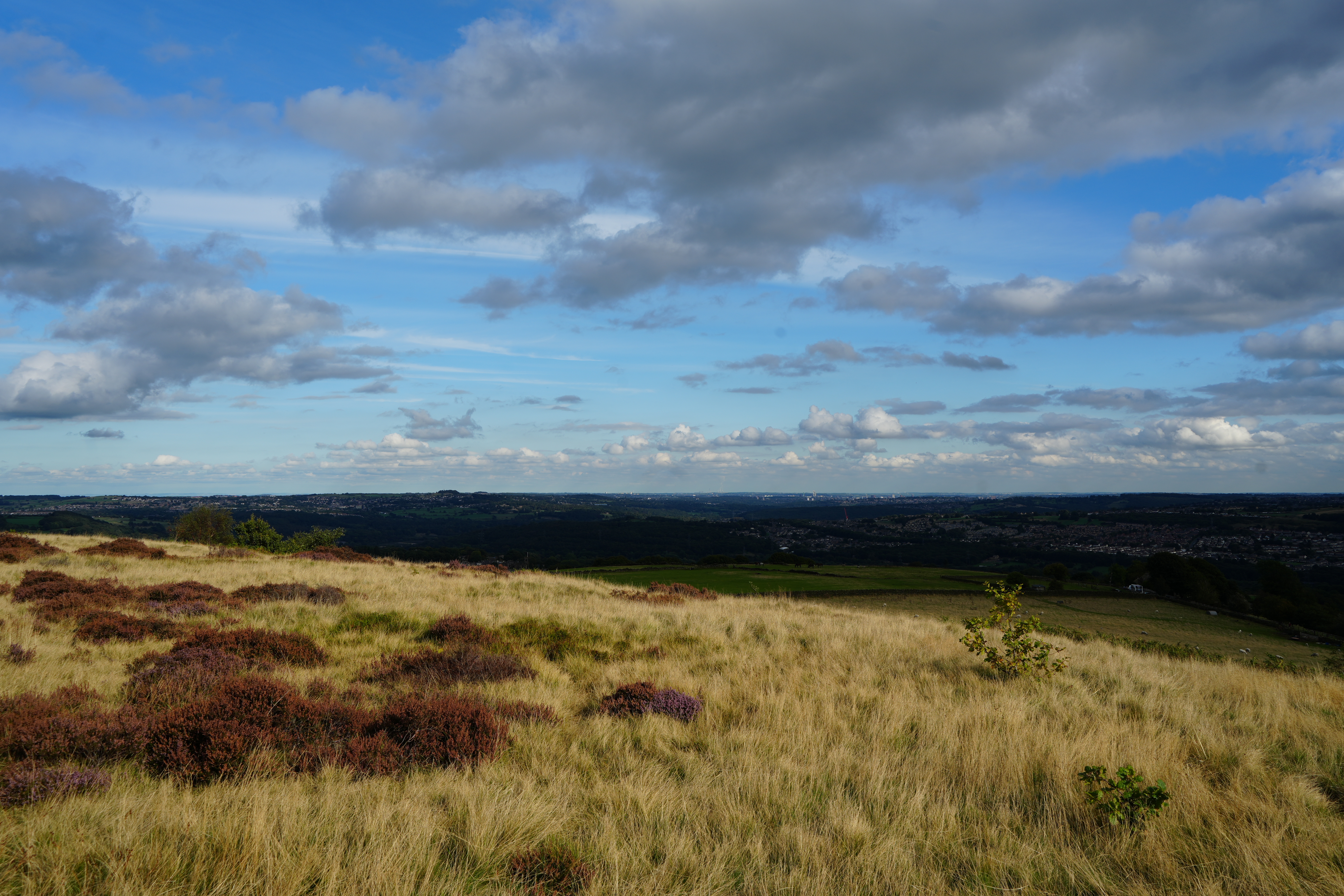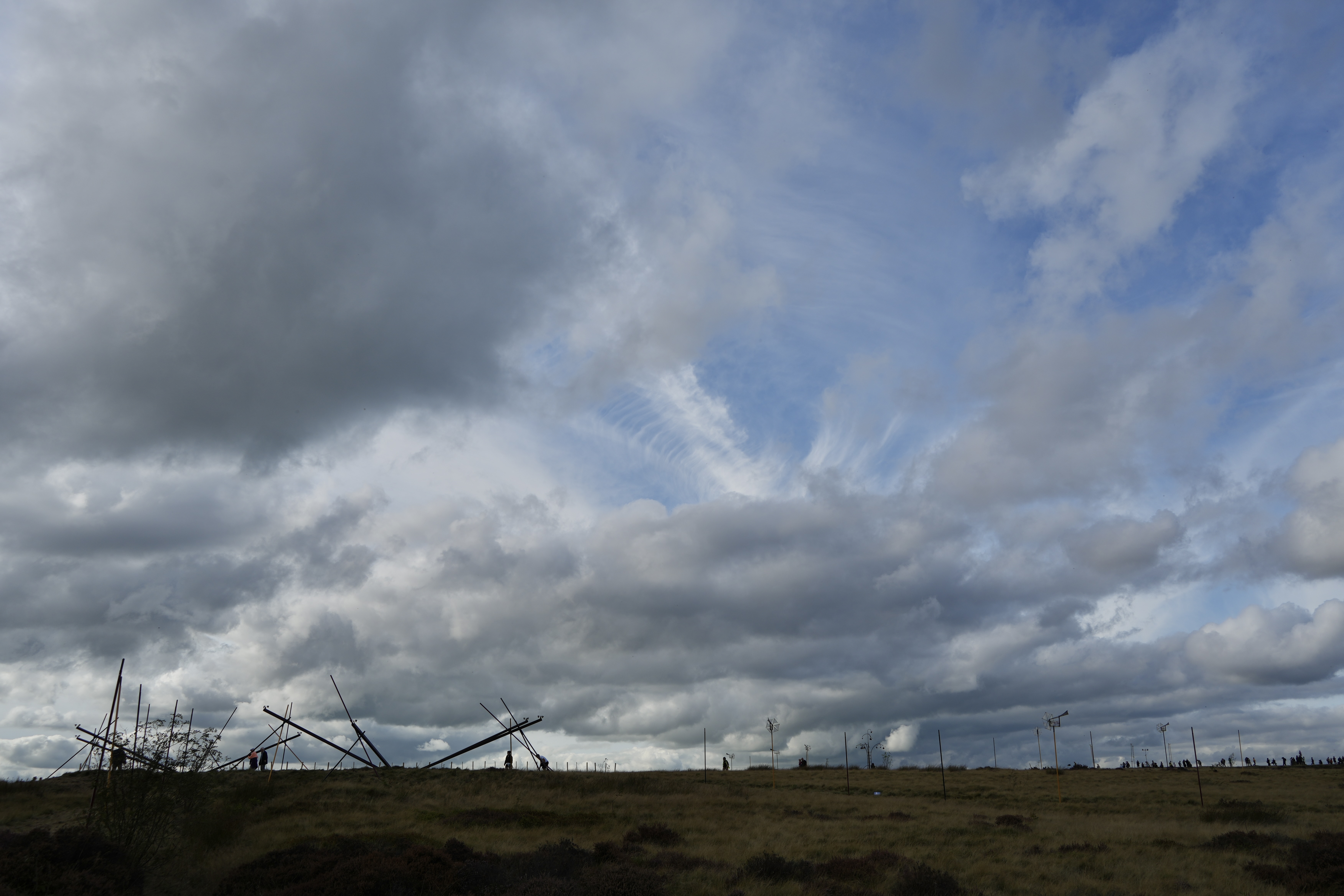
Today I drove over the A65 to meet my friends Ange and Loren to experience something I named Art at the End of the World, though the official title of the installation we had gone to see is Harmonic Fields. This performance involved:
- A wind-orchestra positioned on the top of a Yorkshire moor which is meant to play itself but stood silent and motionless on a hot, utterly and eerily becalmed September day, all the mechanics of sound stilled – idle as painted instruments upon a painted moor.
- A Flying Ant Day entirely out of season and reason. A second Flying Ant Day months after the first. Mark two for doom. Within moments of arriving at the windless site we were covered in flying ants.
- And never a breeze up-blew.
- The only song for several hours coming from meadow pipits disturbed by all the off-lead dogs.
- Heavy-handed signs telling visitors how to experience the (lack of) sound. No cameras! No phones! No talking! Close your eyes! Only listening. No, not in that way. Only this way! This entire post is illegal activity and I approached it all wrong with my eyes open and took photos so all my responses are void.
- Heavy-handed nun-guards in oddly orientalist attire shouting at the children and adults who tried to make sound from the instruments themselves in the lack of wind. I understand protecting the art but there was a mismatch between the families eager to interact and the art which could only be interacted with if weather that had not arrived arrived.
- So many people!
- So many flying ants!
- Absolute lack of any useful signs telling any of the people (or ants) where they’d come from or how to get back there or any information at all.
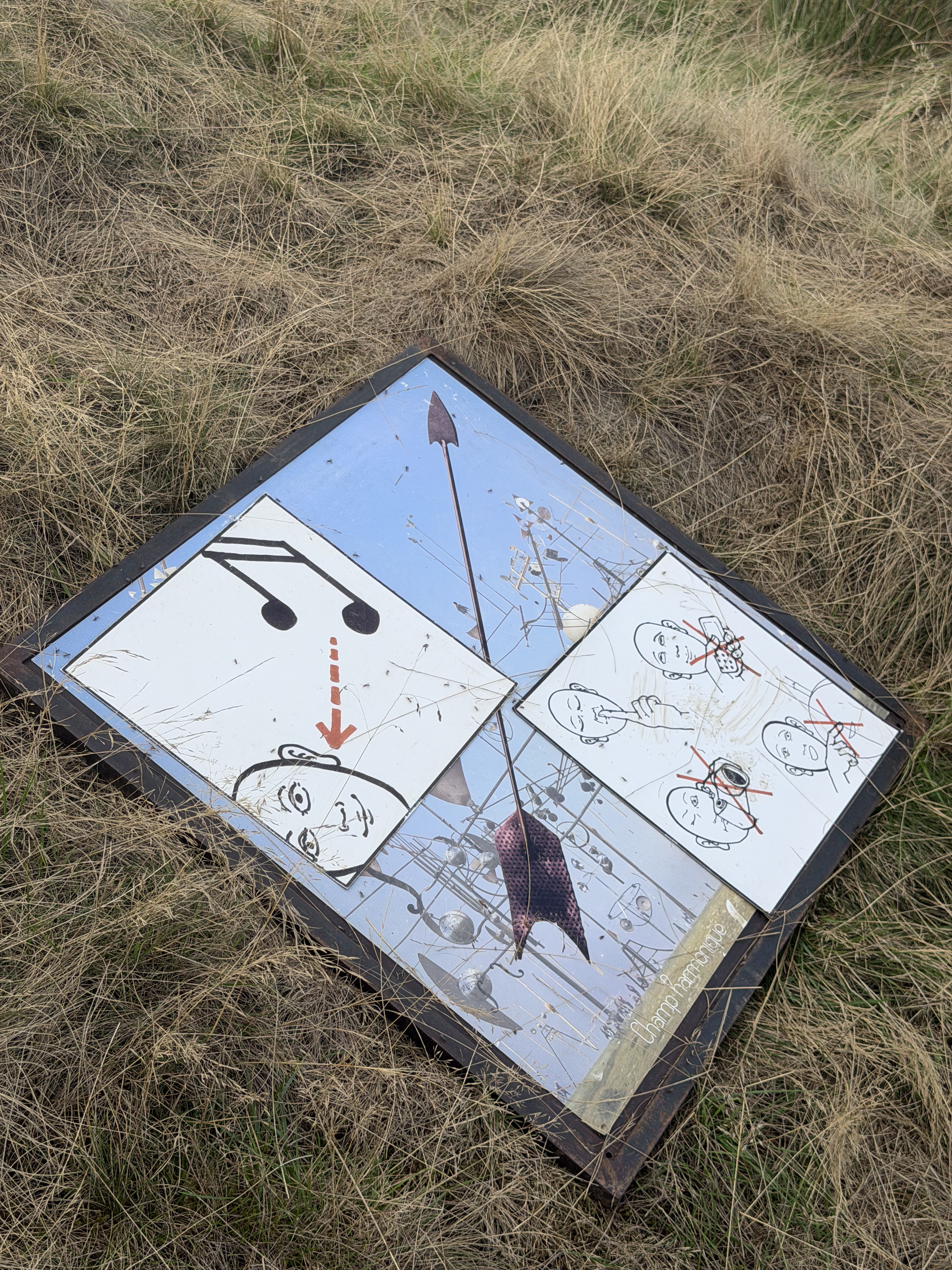
- Shuttle bus from a visitor centre without a car-park – yes – a park-and-ride without any park. General lack of access information. General confusion.
- The instruments themselves rising out of the heather and peat like remnants of a decayed civilisation and its deadly industries – mining, extractive science, war. Ange said sections looked like no-man’s land. I thought some looked like steam-punk apocalypse windmills that could power a small compound on The Walking Dead.
- Across the moors, in all direction, signs of our world eating itself. Xylophone windmills with their fairy tinkling mirrored darkly by giant turbines opposite, staring back at us. Planes rising and falling from the airport, power stations belching their clouds over the sun.
- When a drone buzzed over us several people around us mistook its invasive droidly whirr for the instruments awakening. So much to unpack in that. For several hours these were the sounds of the art: human voices, dog voices, drone, airplane, pippit, the odd bee. Butterflies and flying ants silent as the art.
- Just as we were turning to leave, the wind picked up and the art began to play itself, and yes, it was fascinating and unearthly. The most powerful of the sounds that carried over everything was the tinkling of the wind xylophones that made me think more than anything of the Emmet clock I grew up with in Nottingham – the Aqua Horological Tintinnabulator with its chimes and its dancing animals – and the sense of wonder it brought us all in the mundane setting of the Victoria Shopping Centre.
- As a person pre-disposed to find wonder in such things I was surprised by what I felt today – something more like a low background hum of dread, not unlike the sound of giant strings vibrating in disharmony.
- The failure of sound when sound was the only thing we were meant to be attending to was fascinating. What do you do with hundreds of people who have come to hear the wind sing through a human translator when the wind declines to play? We overheard a lanyarded art worker saying the lack of wind it made it somehow ‘even more epic’ but what it made it was a different kind of performance, a different kind of interaction between landscape, weather and culture, that to me showed how ill prepared we are to adapt to our rapidly changing environment.
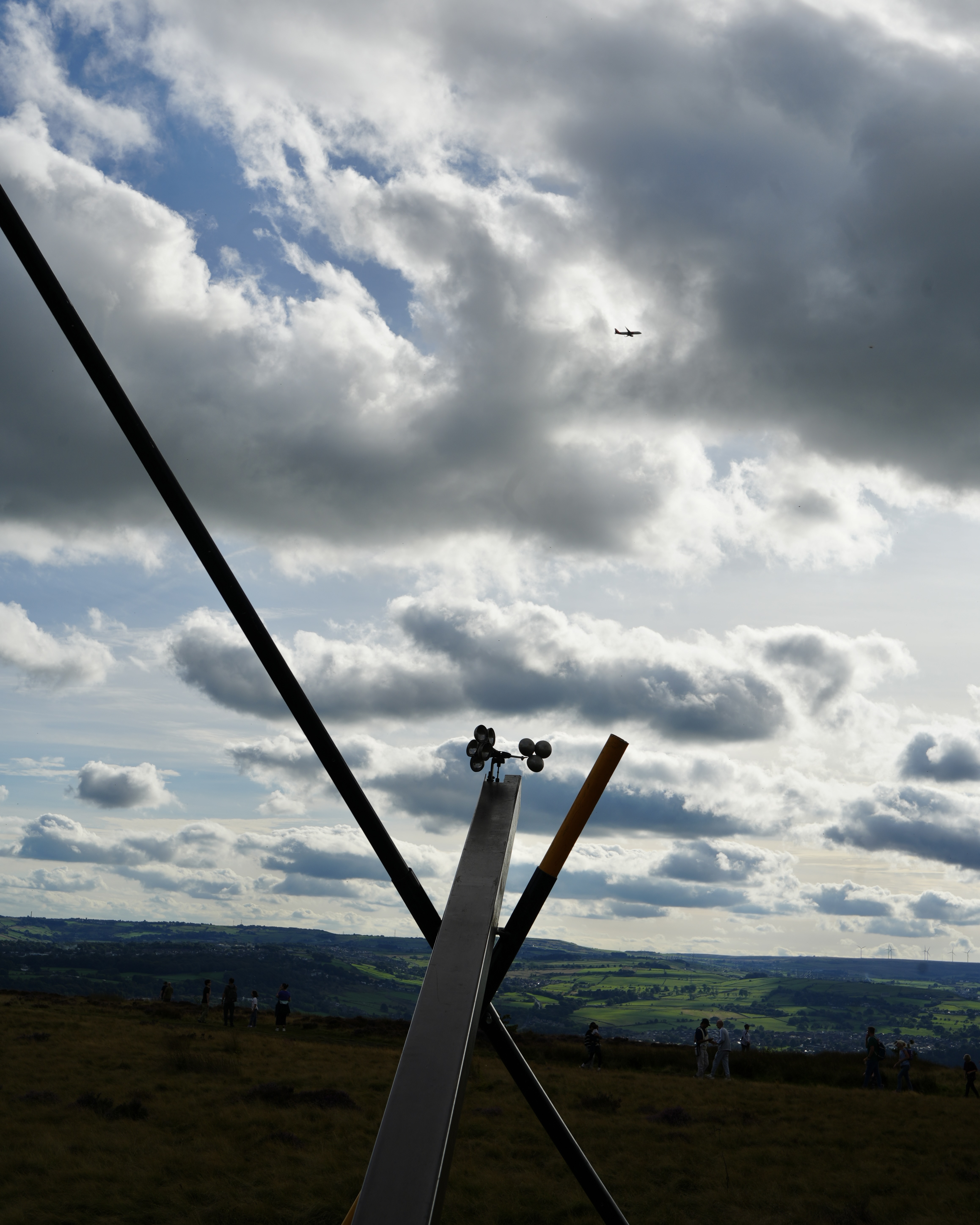
- How much of my response was prepared by listening to the radio on the way – conversation about the conversation about AI and the end of the world – how much by the sudden, surprise heat, echoing the extreme heat of July, the memory of the last time I drove that road – how much by the ants, the power stations, the planes, the echoes of war in the shapes of the metal? How much is something about the note a string vibrates on, and how your cells reply? I don’t know. But I went to see Harmonic Fields and instead I experienced Art at the End of the World. It was a thought-provoking performance. I’m glad I felt it. I was even more glad to get away from it. Although I know we can’t get away from it. Once you’ve heard it, you can’t unhear it.
- Before we went up there, after we’d realised the chaos of arrival, we were talking about hopelessness and helplessness, about that sense of powerlessness in the face of the unfolding human-made catastrophes. I said ‘they want us to feel like there’s nothing we can do, but there’s always something we can do.’ I was thinking about protest and refusal. I was thinking about every action someone is taking right now.
- This wasn’t the message or even the subtext of the art but it was what I found in it. All those classes I taught on denotation and connotation. I took the world in myself to the orchestra on the moor and it played it back at me, eventually, once it had taken a breath.
- Don’t forget, there were also horses. At the edge of the town, running in a field. There were bees and there were children laughing. There were butterflies. There were butterflies. There was bird song. In the silence of the wind. There was song.