
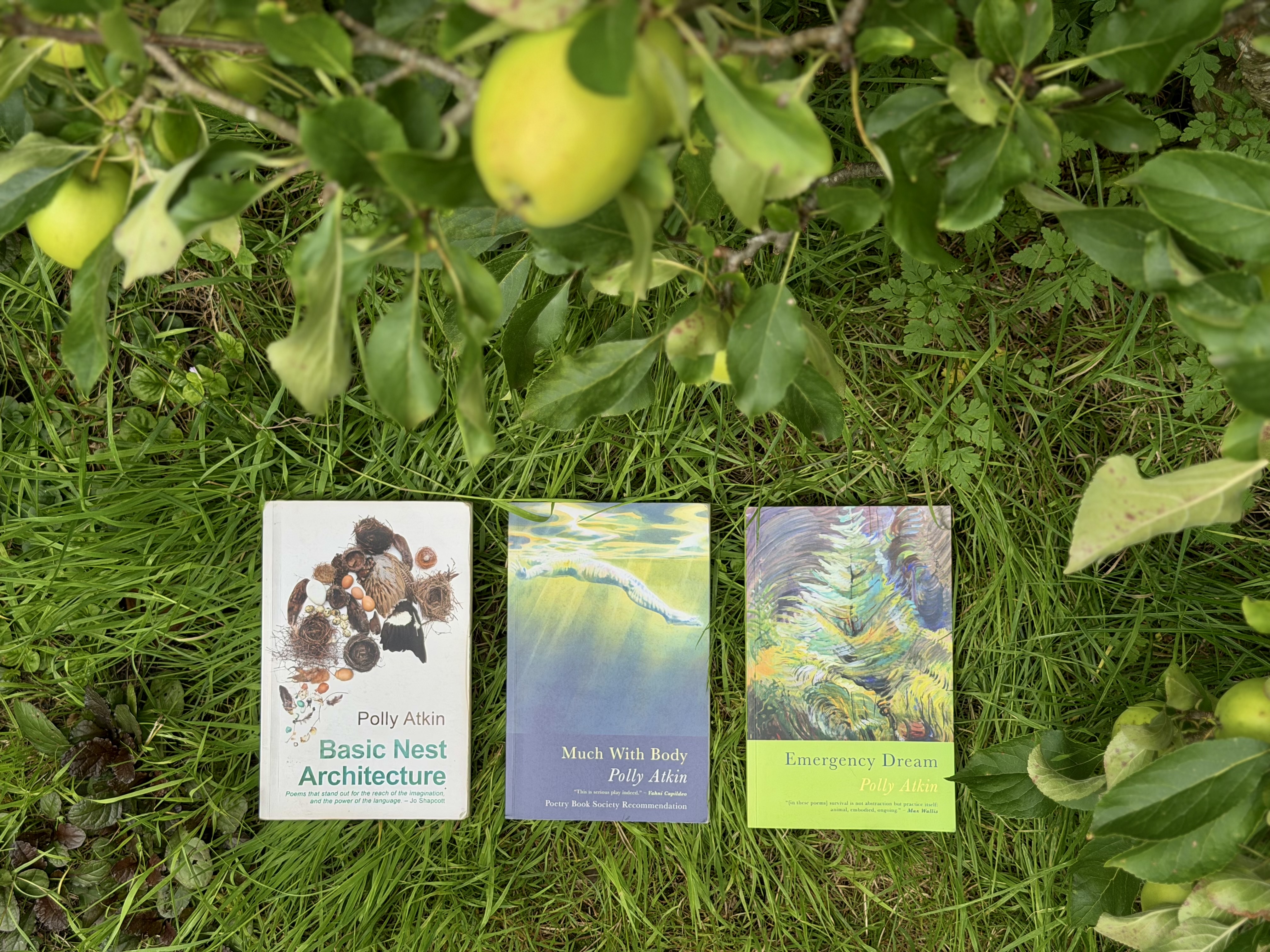
These are my three poetry collections, all published by Seren:
Basic Nest Architecture (2017)
Much With Body (2021)
Emergency Dream (2026)
Yesterday I got my sales figures for the first time since 2017 (there’s been an issue that’s being worked on!) and I thought it would be useful and interesting to share those numbers, after the fabulous Kim Moore shared hers recently for her first and second collections from Seren – an astounding 3000- and 5000-plus respectively. Those would be pretty impressive figures for a mainstream nonfiction book from a big 5 publisher with a moderate marketing budget, so for poetry – especially poetry from a small, independent publisher; especially for a publisher outside London; especially for a Welsh publisher – these are just amazing numbers.
Kim’s brilliant second collection, All the Men I Never Married, won the Forward Prize in 2022. The question of how much difference a prize makes to book sales is constantly eddying back and forth in the swirl of Prize Culture discourse. Much depends on the prize, on its status and its cultural presence, and some on the book itself. Is it as attractive to the reading public as to the judges? A prize does not guarantee sales, but a major prize does bring publicity along with the kudos, and with it, visibility and discoverability to a book that it might not have otherwise, as well as snowballing opportunities to sell it. Other things of course have changed between Kim’s two collections, so I don’t think it’s fair to say the 2000 copy sales difference between the two is all down to winning the Forward Prize, but it will certainly have boosted the numbers for the winner, and I’d think for the earlier collection too.
We so rarely get to see sales data, and track any of these changes. It’s one of the many aspects of publishing that remains obscure, even to people working within it. I’m really grateful to Kim for sharing those numbers, and for the knowledge it gives us all. So I thought I’d share my more modest sales figures too, and reflect on them.
I knew my sales figures would be far fewer for basic logistical reasons. I’ve had many fewer readings and festival appearances; I’ve never been on front row or the verb or poetry please or any such radio programmes; none of my books have been reviewed in the papers; I’ve never had a poem in the Guardian; I don’t teach at a university; none of my poetry collections have won or been shortlisted for any book prizes – in short, aside from anything more personal or specific – my work has less visibility. To be honest, I’m still always surprised when I meet someone I don’t already know in some way who has read any of my poetry.
I think it’s also fair to say that without the greater reach and visibility of my prose writing, my poetry sales figures would be lower than they are.
These are the life sales of my first two collections up till end of March 2026:
Basic Nest Architecture – 826
Much With Body – 944
These aren’t bad numbers at all, especially bearing in mind Basic Nest Architecture hasn’t been available since 2024 (still working on that). I think these are probably pretty average, for most poets and poetry collections, and pretty good for a poet who doesn’t get out much. The good news (for me) is that I’ve earnt out my advances and am owed royalties, which I will get hopefully next year.
The sales data for Emergency Dream only covers half a month of its publication but puts it at 144, which isn’t a bad start.

It’s very hard to find accurate data on poetry sales, especially since a lot of poetry collections are sold in ways that mean sales are not reported to Nielsen BookScan, used by the publishing industry to track sales and make bestseller lists.
If you look it up, you might find claims the average poetry collection sells around 500 copies in its lifetime, but it’s hard to tell what that is based on; if its affected by factors like limited print-runs which mean a book can’t exceed a certain number, and much more.
From the shop I know our real-time data. Since March, we’ve sold over 70 copies of Emergency Dream, but that is certainly not being replicated elsewhere! I only had one invite to read from it at a poetry festival this spring/summer (thanks Litfest!), which automatically limits sales possibilities, and have only had a few readings.
In the statement, I also have figures for my Mslexia Prize winning pamphlet Shadow Dispatches, published in 2013. It’s been out of print throughout this sales period, so it’s been largely static at 229. As with many such pamphlet and small press books, a print-run fixed the upper horizon of its sales potential.
Sales availability or unavailability has its ripple effects. Because of the activism of past writers, I can see that since Basic Nest Architecture has been unavailable to buy, the number of times it has been borrowed from libraries has more than doubled, from 17 loans in 2022-3, to 34 loans in 2023-4 to 78 in 2024-5. This means I have had PLR payments for poetry, which is pretty good for a mid-list, non-book-prize winning poet too (thanks as always to Brigid Brophy and Maureen Duffy).
For a while, Basic Nest Architecture was available on print-on-demand, and I hope to see that happen again soon. In the time being, it should be available to borrow.
Since taking over the bookshop, I’ve been fascinated to see how poetry will sell when it is available to people. Reflecting on our 2025 bestsellers we posted this from Sam Read Bookseller in January:
A lot of people in the book trade – poets and poetry publishers as well as booksellers – believe that poetry doesn’t sell. There’s a negative feedback loop where bookshops don’t think they can sell poetry so they don’t stock much poetry so they don’t sell much poetry, so they stock less poetry. We’ve found the greater the selection we have, the more we sell.What does selling or not selling mean in this context?
Our top seller of 2025 in poetry was Simon Armitage’s ‘Dwell’, which with 53 copies sold across the calendar year was the only contemporary poetry to make it into our general bestseller list. L.A. Baby sold 13 copies, but most of the books on [our 2025 bestseller] list sold 6 or 7 times in the year to get onto it.
In the shop we have a bay dedicated to poetry and a separate section for the lake poets, with anthologies and gift collections creeping into other areas of the shop, and some display space for new collections we want to especially highlight. We know poetry isn’t going to turn over at the same rate as eg. Local Crime, but we see it as an important part of what we do to have an extensive poetry section. We import collections not available in the UK and make sure we have small presses represented as well as the main poetry presses.
We have of course the enormous privilege of our location to help support and justify this – we are in the centre of a village that has constant visitors directly because of the poets who lived here 200 years ago. Eat that, misquoters of Auden! Many bookshops simply couldn’t risk giving over as much space to stock that turns over as slowly as poetry tends to though.
Even with our fingers – we would like to think – on the poetry pulse, we still miss new collections coming out, and find it hard to discover new work. Much bookshop stock is chosen through meetings with sales reps, which don’t happen with poetry presses. Many rely on digital catalogues, which require more work from the bookseller. Larger publishers with poetry imprints rarely include their poetry publications in their highlights or in the packs their reps will show to bookshops, so you still have to dig the information out, which is not easy when you’re dealing with so many other, more discoverable books. Even if you know about the books you want to stock, some poetry presses feel bizarrely hard to order from, or have really tiny trade discounts, meaning they’re taking up space for very little return. In short: you have to have a certain amount of dedication to contemporary poetry as a bookseller to manage to stock it.
This troubles me constantly, both as a bookseller, and a poet. How can we buy a thing, if we can’t find it? I see all the time in the shop how simply having a book on the counter or on a table leads to sales. Not every book can have this privilege of display, nor for long, but if a book isn’t present at all, it definitely can’t sell.
I’m not sure how many readers and book-lovers know that you can always ask your local bookshop to source a book for you that they don’t have, just as you can ask your local library, and both of these are really useful to writers. As booksellers, this is a great way of learning about books that readers really want, that we might not know about. Sometimes we’ll then add them to our core stock if the demand is high.
Poetry presses often rely largely on direct sales, and on poets selling at events, as more effective than trying to get stock into shops who don’t really know what to do with it. I really understand this, in a culture that hasn’t valued poetry highly, but it has the side-effect of perpetuating the idea poetry doesn’t sell from shops. The focus on hand-selling at events disadvantages poets who do fewer events, and contributes to the lack of sales data, making poetry sales effectively invisible to the rest of the book industry and – yes – you guessed it – again perpetuating the idea that poetry doesn’t sell from shops. You see the feedback loop?
It doesn’t sell, so it doesn’t sell.
I, obviously, have a vested interest in disrupting this loop. I’d love to be able to trust that my books will sell without me having to be placing them directly into people’s hands. Not that I wouldn’t like to be doing more of that. I’d love to do more events.* I’d love to be on the radio talking poetry. But I’m not. At the moment what I have is two things: a plea for people to buy books from the writers they’d like to see continue writing, whose work they’d like to see continue circulating; and a faith that enough people will.
* next up you can see me reading from Emergency Dream at Push The Boat Out in November.

